Understanding Volcanic Gas Movement at Ijen Crater
Key Takeaways:
- Gases are densest at the crater floor near the active vents.
- Wind direction dictates which parts of the rim are “safe” or “choking.”
- Temperature inversions often keep gas low and concentrated before dawn.
- A high-quality gas mask is non-negotiable for all visitors.
About This Guide: Written by our Banyuwangi-based local operational team with first-hand field experience across East Java, including current trail conditions, departure timing, weather shifts, and real visitor logistics.
Table of Contents
What Is the Ijen Volcanic Gas Plume?
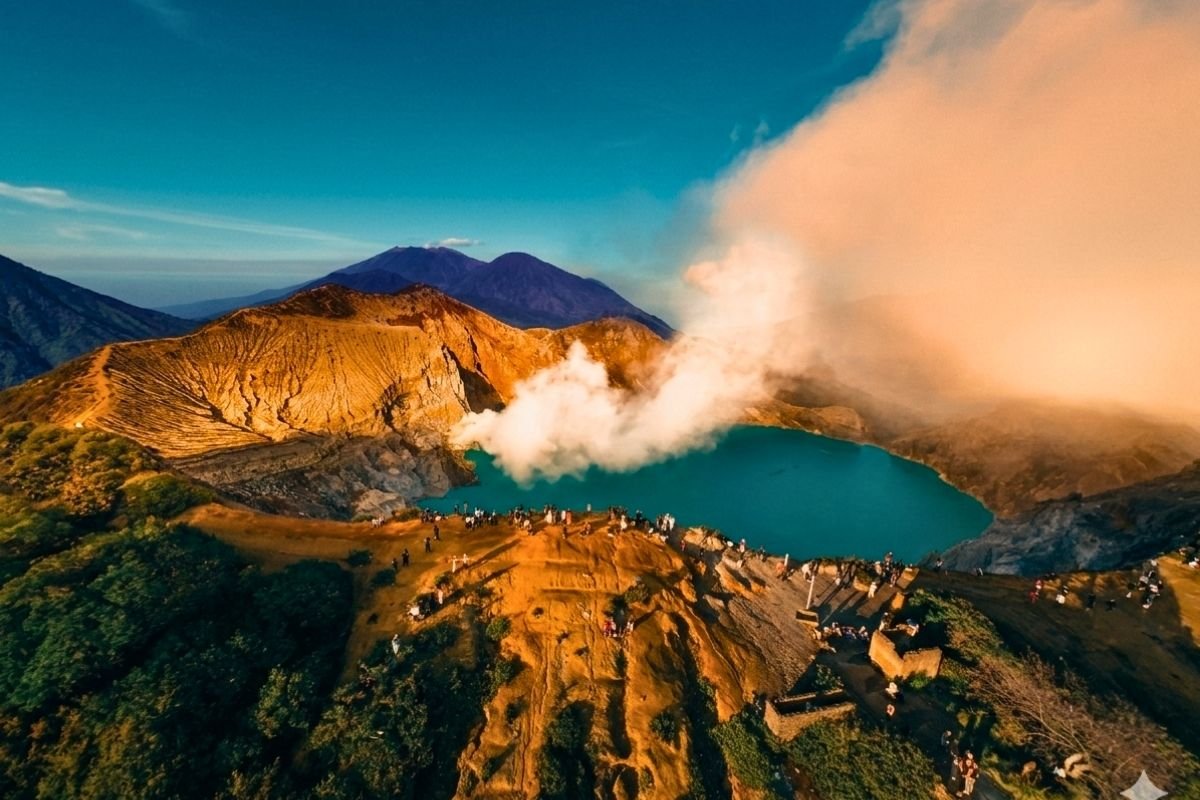
The white clouds you see billowing from the depths of Ijen aren’t just steam. They are a potent cocktail of water vapor, sulfur dioxide, and hydrogen chloride. These gases originate from the magma chamber deep below the acidic crater lake, which maintains a pH of less than 0.5.
When these gases reach the surface through solfatara vents, they ignite upon contact with air if the temperature is high enough—creating the famous blue fire. However, once they cool slightly, they form the thick, rolling plume that defines the Ijen landscape. This gas is heavier than air, meaning it tends to “flow” down slopes and settle in low-lying pockets of the caldera.
Understanding how this gas moves isn’t just about science; it’s about your comfort. One minute you’re breathing clear mountain air, and the next, a shift in the breeze brings a wall of acrid sulfur that makes your eyes water. Here is how that movement actually works.
The Mechanics of Gas Movement
Gas movement at Ijen is a dance between volcanic pressure and atmospheric conditions. The vents at the bottom of the crater act like a giant chimney, but without a roof. This means the gas is at the mercy of the surrounding environment the moment it exits the pipes used by the ijen sulfur miners.
The Chimney Effect
Because the gas is hot when it leaves the vents, it initially wants to rise. This is the “chimney effect.” On a perfectly still, warm morning, the gas may rise vertically, towering over the summit peak at 2,386m. However, still air is rare at these altitudes. Most often, the gas is immediately caught by the prevailing winds at the rim.
Nocturnal Accumulation
Between 02:00 AM and 05:00 AM, the air is cold. Cold air is dense and sits heavy in the crater. This creates a “lid” effect where the volcanic gases get trapped near the crater floor. If you are heading down to see the ijen blue fire explained by local guides, you will notice the gas is much thicker at the bottom than at the rim during these hours.
Factors Influencing Gas Direction
The wind is the primary director of the sulfur show. At Ijen, the wind doesn’t just blow across the top; it swirls inside the bowl of the caldera. This creates unpredictable “eddy currents” where the gas might suddenly loop back toward the trail.
Topographic Funneling
The crater rim isn’t a perfect circle. It has low points and high peaks. Wind tends to funnel through the lower gaps in the rim. This is why certain viewpoints, like the “dead tree” area, are often clearer than others. The wind pushes the gas through specific “valleys” in the rim walls, effectively clearing some zones while saturating others.
Seasonal Wind Shifts
During the dry season, winds are often more stable, blowing consistently from one direction. During the transition between seasons, the wind can be chaotic. If the wind blows from the west, the main hiking trail on the east rim stays clear. If it flips, the entire trail can become engulfed in a white-out of sulfur gas.
Practical Information
When planning your visit, keep these operational facts in mind. The gas movement isn’t just a visual phenomenon; it dictates whether the trail is even open for the day.
- Location: Licin/Banyuwangi, East Java.
- Opening Hours: 02:00 AM (Subject to volcanic gas alerts).
- Mandatory Requirement: Health Certificate (Surat Keterangan Sehat) from a local clinic.
- Essential Gear: Dual-filter gas mask (can be rented at Paltuding).
- Temperature: 3°C to 12°C at the summit before sunrise.
- Distance: 3km uphill hike from 1,850m to 2,386m.
Gas Density: Rim vs. Crater Floor
Depending on where you stand, the gas movement affects you differently. Here is a breakdown of what to expect in terms of exposure levels.
| Location | Gas Density | Wind Impact | Safety Requirement |
|---|---|---|---|
| Crater Rim | Low to Medium | High (Wind clears it fast) | Mask on standby |
| Crater Floor (Vents) | Extreme | Low (Gas settles here) | Mask strictly required |
| Sunrise Point | Low | Moderate | Generally safe |
Local Tips for Navigating the Plume
Look, the sulfur is part of the experience, but it doesn’t have to be miserable. Truth is, if the wind is blowing the gas toward you, don’t try to “tough it out.” Use your gas mask rental early. Here are a few insider tricks we use on our tours:
Watch the miners: The local sulfur carriers are the best “wind vanes.” If you see them suddenly stop or move to a different side of the path, follow their lead. They know the swirling patterns better than any weather app.
Stay low if it’s light: If a small puff of gas hits you, crouch down or turn your back to the wind. However, if it’s a thick cloud, don’t hesitate—put the mask on immediately. More info on safety can be found in our safety guide.
Check the PVMBG status: Before you even leave your hotel, we check the official volcanic activity reports. If the gas concentration is too high, the authorities will close the trail down to the crater floor. Trust the rangers; they are monitoring the SO2 levels in real-time.
Safety & Important Considerations
Volcanic gas is no joke. Long-term exposure or high-concentration short-term exposure can cause respiratory distress. If you have asthma or heart conditions, the hike difficulty combined with the gas can be a serious risk. This is why the health certificate is now mandatory for every hiker.
Remember that the trail officially opens at 02:00 AM WIB. If you are coming from Bali, remember that Java is one hour behind Bali. Arriving too late means the sun will be up, the air will be warmer, and the wind will often start pushing the gas directly onto the viewing rim.
Frequently Asked Questions
Q: Is the volcanic gas always present at Ijen?
A: Yes, the vents are active 24/7. However, visibility and density change constantly based on wind speed and air pressure. Some days are remarkably clear, while others are dominated by thick white plumes.
Q: Can I hike without a gas mask?
A: It is strongly discouraged and often prohibited by rangers at the rim. Even if the air looks clear, a sudden wind shift can bring a pocket of SO2 that will cause immediate choking and eye irritation.
Q: Does the gas affect the Blue Fire visibility?
A: Absolutely. If the gas is too thick and there is no wind to move it, the blue flames are often hidden behind a wall of white smoke. Clearer, windier nights usually offer the best views of the electric-blue glow.
Q: What happens if the wind blows the gas onto the hiking trail?
A: You will need to wear your mask for that section. If the gas is too dense and doesn’t move, rangers may temporarily block access to the crater rim or the descent path for safety.
Q: Is the gas dangerous to my camera or phone?
A: Sulfur gas is corrosive. If you are in thick gas for a long time, it can affect electronics. It’s best to keep your gear in a bag when not shooting and wipe it down with a damp cloth after your hike.
Recommended Tour Packages
- Ijen Crater Tour from Banyuwangi (1 Day) – The most direct way to see the gas movement and blue fire with local experts.
- Ijen Crater Tour from Bali – A complete midnight transfer package including ferry crossings and full gas mask gear.
- 3D2N Bromo Ijen Tour from Surabaya – A comprehensive volcanic journey across East Java’s most famous peaks.
- 3D2N Bromo Ijen Tour from Bali – Explore the Sea of Sand and the acidic Ijen lake in one epic trip.
- 2D1N Ijen Crater Tour from Banyuwangi – A slower-paced option that allows for better rest before the midnight hike.
Final Takeaway
The movement of volcanic gases at Ijen is a dynamic, living part of the mountain. While it creates one of the most otherworldly landscapes on Earth, it demands respect. By understanding that the gas is heaviest at dawn and moves with the swirling winds of the caldera, you can better prepare for your hike. Always carry a mask, listen to your local guide, and keep an eye on the wind. According to official geological data, Ijen remains one of the most active hydrothermal systems in the world, making every visit a unique encounter with the earth’s raw power.
Planning Your Trip to East Java?
Explore our local tour options and choose a route that matches your travel schedule.