
What Is the Difference Between Mount Ijen and Ijen Crater?
Key Takeaways:
- Mount Ijen is a “Volcanic Complex” spanning multiple peaks.
- Ijen Crater is the specific geological feature people visit.
- The summit of Mount Ijen sits at 2,386 meters above sea level.
- The crater lake is the most acidic body of water on the planet.
About This Guide: Written by our Banyuwangi-based local operational team with first-hand field experience across East Java, including current trail conditions, departure timing, weather shifts, and real visitor logistics.
Table of Contents
- Defining the Difference: Massif vs. Feature
- What Is Mount Ijen? The Volcanic Complex
- What Is Ijen Crater? The Active Heart
- Geological Evolution: How They Formed
- The Hike: From Paltuding to the Rim
- Practical Information for Visitors
- Side-by-Side Comparison
- Safety & Volcanic Hazards
- Common Mistakes Travelers Make
- Frequently Asked Questions
- Recommended Tour Packages
Defining the Difference: Massif vs. Feature
Here’s the deal: most travelers use the terms interchangeably. You’ll hear someone say, “I’m climbing Mount Ijen,” and another say, “I’m visiting the Ijen Crater.” Technically, they’re both right, but they refer to different scales of the same landscape.
Think of it like a house. Mount Ijen is the entire property, including the yard, the walls, and the roof. The Ijen Crater is the kitchen—the specific room where all the heat, action, and chemical reactions happen. If you want to see the Blue Fire, you aren’t just looking for a mountain; you’re looking for the specific vent inside that mountain’s crater.
In the world of geology, Mount Ijen belongs to a massive caldera system. When you book an Ijen Crater tour, you are physically trekking up the slopes of the Mount Ijen massif to peer into the active mouth of the volcano.
The Semantics of “Kawah”
Local Indonesians almost always refer to the destination as Kawah Ijen. “Kawah” means crater. This is because the surrounding peaks, like Mount Merapi (not the one in Yogyakarta) and Mount Raung, are part of the same skyline. The distinction is vital for navigation and understanding the terrain you are about to face.
What Is Mount Ijen? The Volcanic Complex
Mount Ijen isn’t a single isolated cone like Mount Fuji. It’s actually a “volcanic complex.” This means it consists of several volcanic structures that have grown over thousands of years. The highest point is the summit of Mount Merapi, which stands at 2,800 meters, sitting on the eastern edge of the complex.
For an in-depth look at how this massive structure changed over eons, check out our guide on Mount Ijen evolution. It details how the landscape shifted from a single massive volcano to the complex we see today.
When you stand at the basecamp in Paltuding, you are already high up in the complex at 1,850 meters. The air is crisp. You can see coffee plantations and thick ferns. This entire region is part of the Ijen Caldera, a massive 20-kilometer-wide depression created by an ancient, cataclysmic eruption.
A Cluster of Peaks
The complex includes several other mountains like Mount Jampit and Mount Blau. Most people never summit these. They focus purely on the path leading to the active crater. The massif acts as a natural wall, trapping moisture and creating the unique cloud forests you’ll walk through during the first 45 minutes of your hike.
What Is Ijen Crater? The Active Heart
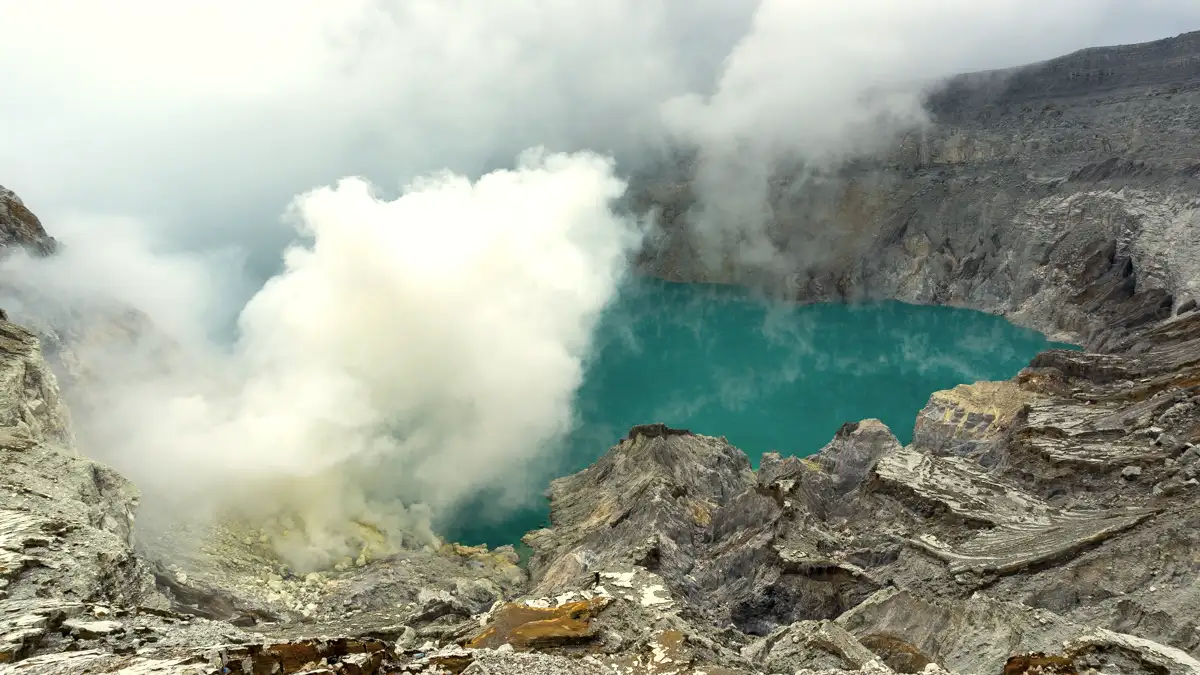
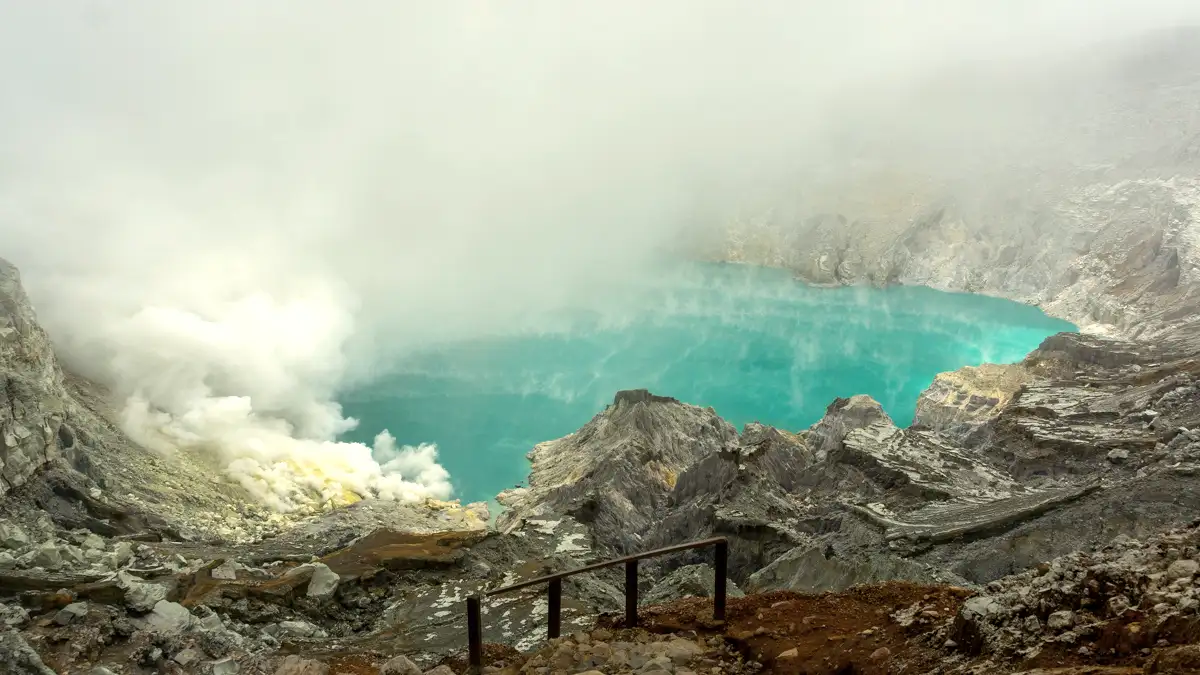
The Ijen Crater is where the magic (and the sulfur) happens. It is a one-kilometer-wide caldera filled with turquoise water. But don’t let the color fool you. This isn’t a tropical swimming hole. Because of the high concentration of sulfuric acid, it’s widely considered the world’s most acidic crater lake.
This is also the site of the famous Blue Fire phenomenon. This isn’t lava. It’s actually sulfuric gas that ignites upon contact with the oxygen-rich air at temperatures exceeding 600°C. You can only see it in the dead of night, which is why most tours start at 2:00 AM.
The Sulfur Mines
Inside the Ijen Crater, you’ll witness one of the most grueling jobs on earth. Miners climb down into the active vent to break off chunks of solid yellow sulfur. They carry baskets weighing up to 90kg back up the steep crater walls. It is a stark, humbling sight that defines the human element of this volcanic landscape.
Geological Evolution: How They Formed
The story of Ijen began over 300,000 years ago. Originally, a massive “Old Ijen” volcano dominated the skyline. About 50,000 years ago, a colossal eruption caused the center of the mountain to collapse, creating the caldera. Over time, smaller volcanic cones grew within and around this hole.
The facts about Ijen Crater are mind-blowing. The lake’s pH is near zero, similar to battery acid. This happens because volcanic gases like sulfur dioxide dissolve into the water, creating a potent acidic cocktail. This chemical factory is the reason the rocks in the crater are bleached white and the water is a surreal milky green.
Ongoing Activity
While the Ijen complex is relatively stable, the crater itself is very much alive. The PVMBG (Indonesian Volcanology Agency) monitors the gas levels daily. If the “heart” of the mountain gets too restless, the trail is closed to the public. This is why checking current conditions is non-negotiable before you drive out to the basecamp.
The Hike: From Paltuding to the Rim
To see the Ijen Crater, you must hike the slopes of Mount Ijen. The trail starts at the Paltuding Ranger Post. Honestly, the first two kilometers are the hardest. It’s a steep, dirt path that winds up at a 20-30 degree incline. There are no stairs, just a steady, calf-burning grind through the trees.
Many people ask, how difficult is the Ijen hike? If you have average fitness, you’ll be fine. Just take it slow. You’ll pass a halfway point called “Pondok Bunder,” where you can grab a quick snack. After this point, the trail levels out significantly as you traverse the rim of the massif.
The Final Ascent
The last kilometer is easy and flat, but the wind picks up. This is where you feel the altitude. At 2,300 meters, the temperature can drop to 3°C or 5°C. You’ll want to check our Ijen temperature guide so you don’t end up shivering at the summit in just a T-shirt.
Practical Information
| Location | Banyuwangi / Bondowoso border, East Java |
| Opening Hours | 02:00 AM – 12:00 PM (Daily) |
| Total Distance | 3.5 km one way (7 km round trip) |
| Best Time to Visit | Dry Season (May to September) |
| Requirements | Health Certificate (Surat Sehat) & Gas Mask |
Side-by-Side Comparison
To keep it simple, here is how the two entities compare in terms of visitor experience.
| Feature | Mount Ijen (The Massif) | Ijen Crater (The Destination) |
|---|---|---|
| Physical Type | Volcanic Complex / Mountain | Active Crater / Acid Lake |
| Primary Activity | Hiking, cloud forests, trekking | Blue Fire, sulfur mining, lake views |
| Terrain | Steep dirt paths, pine trees | Sharp volcanic rock, sulfur smoke |
| Hazards | Cold temperatures, steep slopes | Toxic gas, acidic water, loose rock |
Safety & Volcanic Hazards
Look, you’re not just climbing a hill; you’re entering an active volcanic zone. The main danger isn’t the mountain itself, but the gases inside the crater. Hydrogen sulfide and sulfur dioxide can irritate your lungs and eyes instantly. This is why a gas mask is mandatory for anyone descending into the crater floor.
Is it safe? Generally, yes, provided you follow the rangers. We’ve written a detailed breakdown on Ijen Crater safety that covers gas levels and volcanic alerts. Always listen to your guide. If the wind shifts and the smoke heads your way, you move. Fast.
The Mandatory Health Certificate
As of 2024, the government requires all hikers to present a health certificate (Surat Keterangan Sehat). This is a simple document stating you have no heart or lung issues. You can get these at local clinics in Banyuwangi for a small fee. Don’t skip this, or they won’t let you buy a ticket at the gate.
Common Mistakes Travelers Make
1. Thinking the Blue Fire is Guaranteed: The fire is a natural phenomenon. Heavy rain or excessive sulfur smoke can hide it. Don’t get angry at your guide if Mother Nature doesn’t cooperate.
2. Underestimating the Cold: Java is tropical, but at 2,300 meters, it feels like late autumn in Europe. Bring a jacket, gloves, and a beanie.
3. Arriving Without a Gas Mask: You can rent them at Paltuding, but many are poorly maintained. If you’re sensitive to smells, bring your own or ensure your tour provider provides a high-quality respirator.
4. Ignoring the 12:30 AM Start: If you’re coming from Bali, you need to leave around 7:00 PM. It’s a long journey involving a ferry crossing. If you leave too late, you’ll miss the Blue Fire entirely.
5. Booking Based on Price Alone: Cheap tours often cut corners on transport safety and guide expertise. When you’re standing on the edge of an acid lake in the dark, you want a guide who knows exactly where the safe paths are.
Many travelers find it easier to come from across the water. If you’re planning this, read our advice on the Ijen tour from Bali to manage the logistics of the ferry and the time zone change (Java is one hour behind Bali).
Frequently Asked Questions
Q: Can I see the Blue Fire from the top of Mount Ijen?
A: Not clearly. You can see a glow from the rim, but to truly witness the Blue Fire, you must descend 800 meters down a rocky path into the crater itself.
Q: Is the sulfur smoke dangerous?
A: Yes, in high concentrations. Short-term exposure causes coughing and eye irritation. A professional gas mask with a chemical filter is required to stay safe near the vents.
Q: Is Mount Ijen the same as Mount Merapi?
A: Within the Ijen complex, there is a peak called Mount Merapi. However, it is not the same as the famous, highly active Mount Merapi located near Yogyakarta in Central Java.
Q: Do I need a guide to reach the crater?
A: While the trail to the rim is straightforward, having a local guide is highly recommended for the descent into the crater and for navigating the complex ferry/health certificate logistics.
Q: What is the best month to visit?
A: The dry season from July to September offers the clearest skies and best trail conditions. During the rainy season, the path can become slippery and the Blue Fire is harder to see.
Recommended Tour Packages
If you’re ready to see this geological wonder for yourself, here are our top-rated routes managed by our local team:
- Ijen Crater 1-Day Tour from Banyuwangi: The most efficient way to see the Blue Fire if you are already in Java. Includes transport, gas mask, and a local guide.
- 3D2N Bromo Ijen Tour from Surabaya: The ultimate East Java volcano circuit. See the sunrise at Bromo and the blue flames at Ijen in one seamless trip.
- 4D3N East Java Adventure from Bali: A comprehensive luxury/adventure hybrid including Ijen, Bromo, and the massive Tumpak Sewu waterfall.
Final Takeaway
Truth is, whether you call it Mount Ijen or Ijen Crater, you’re heading toward one of the most spectacular natural sites on the planet. Just remember: Mount Ijen is the journey, and the Ijen Crater is the reward. Respect the mountain, bring your warm gear, and prepare for a sensory experience unlike anything else in Indonesia.
Planning Your Trip to East Java?
Explore our local tour options and choose a route that matches your travel schedule.
Planning to visit Ijen or Mount Bromo?
Explore available tour options and ask our local team about your itinerary.
Explore Tour Packages →